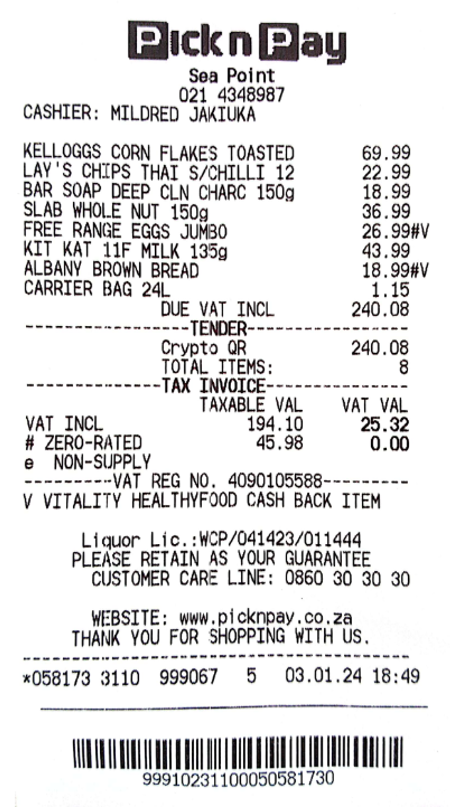
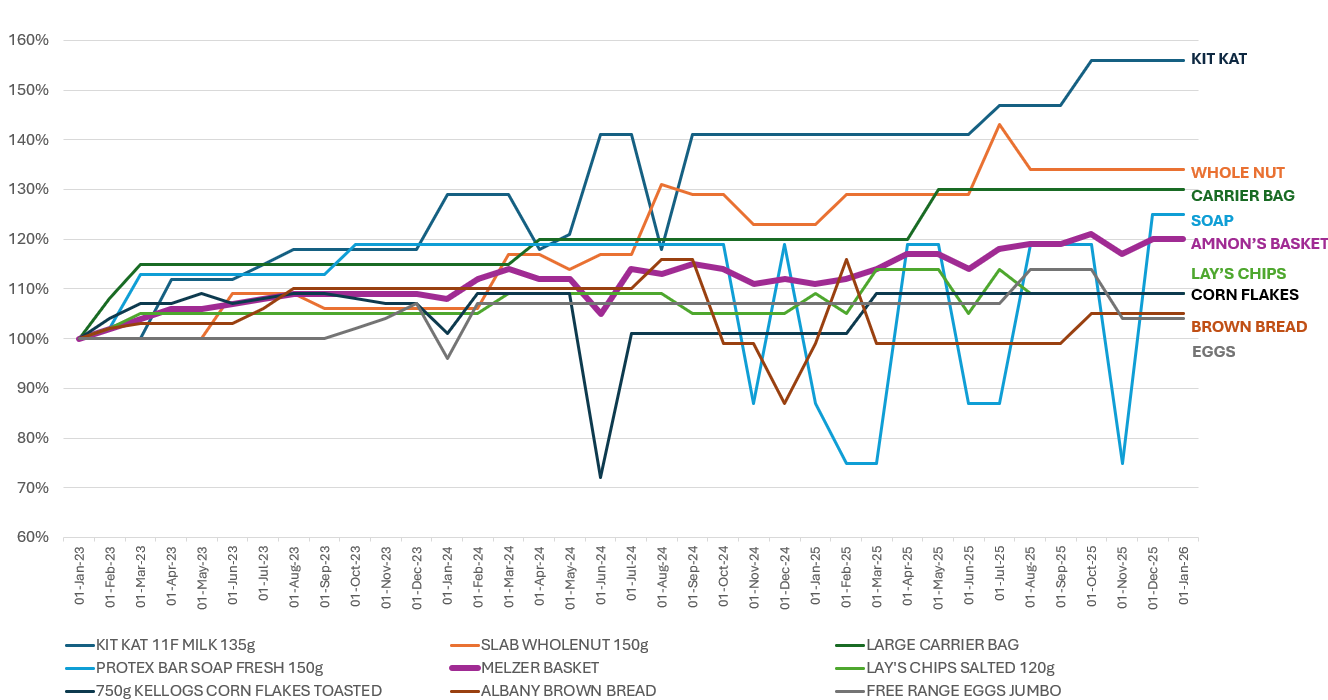
Notwithstanding the simplicity of the basket, Amnon has encountered some of the complexities that plague statistical bureaus worldwide as they track inflation. For instance, it is not uncommon for Pick n Pay (and other retailers) to offer multibuy promotions inducing shoppers ‘buy three for the price of two’. The impact of these promotions on the real prices consumers pay is not nominal, but taking three items off the shelf would require an amendment to the standard basket, and that is a slippery slope.
Likewise, loyalty points and discounts effectively reduce prices for smart shoppers. While Amnon (and presumably Stats SA) ignores these, Pick n Pay maintains that its SmartShopper programme generates over R7bn in savings per annum for customers[1]. Given total Pick n Pay revenue for FY 2025 of R76.3 billion that is sizeable indeed. The implication is that the prices consumers actually pay may be lower than Amnon and Stats SA report. But on the other hand, omitting them is justifiable. If points and discounts are ever-present, they would not affect price changes, the primary issue under scrutiny.
It is less clear how to deal with temporary price discounts that may be here today and gone tomorrow. For instance, the price of Corn Flakes dropped dramatically in June 2024 and recovered somewhat in July 2024. At that time, prices of yellow corn (the primary ingredient of Corn Flakes) were on an upward trend. Given that yellow corn accounts for around 22-24% of the retail price of Corn Flakes (according to Claude, my new favourite but not always reliable analyst) and eyeballing Pick n Pay’s financials, this promotion may have been a mistake. Nevertheless, unlike conditional promotions and loyalty points which are ignored, Amnon does incorporate once off discounts into the basket price.
The basket composition itself is also tricky. Amnon’s basket is poorly constructed because he is doing this for entertainment rather than research purposes. While the products themselves might be correct, the ratios are all wrong. For every 750g box of Kellogs Corn Flakes consumed in the household, the basket should contain at least six Kit Kats and another six Whole Nuts. This adjustment alone would increase AFPI to 10.6%.
Basket changes present a deeper problem. Amnon’s food preferences have not changed since he started eating. They are immune to both price signals and spousal influence. Most people are not Amnon. When the price of Whole Nut rises faster than the price of Lay’s chips, consumers tend to switch. The basket changes because prices changed. But to measure the price change, the inflation measure assumes the basket does not change. The circularity is not a flaw in the methodology. It is an inherent feature. Those who use inflation numbers (in wage negotiations for instance) would do well to acknowledge this. You cannot hold consumption fixed and call associated prices the cost of living, an activity that is fundamentally dynamic and responsive.
In addition, new products become available and product features change, also impacting on baskets. This happened even in Amnon’s very small basket. Protex increased the size of the standard bar of soap from 150g to 175g, a rare act of generosity in a world of shrinkflation.
This challenge is hard to wash away. But statistical bureaus simply ignore the reality of dynamic, responsive baskets settling instead for periodic updates. The frequency of these updates is constrained by real world costs. It takes a lot of time and money to determine the basket for various segments across the country. Stats SA reportedly spent over R200 million on the 2022/23 Income and Expenditure Survey, one of whose primary purposes is precisely this task. Over 30 000 households were approached to keep detailed weekly diaries recording every single item they purchased. Around 21 000 actually did, no doubt with varying accuracy and honesty in some categories more than others.
Stats SA must do the best it can with the data it gets. Other bureaus have started experimenting with point-of-sale data (and statistical contortions) to reweighting the food basket.
Amnon has refused to adopt this exciting, and in his case, entirely feasible innovation. He prefers the real-world visit to the supermarket, fighting for a parking spot, looking for products on the shelf and then standing in line only to find he has left his wallet at home.
Amnon’s exercise does not just illustrate the inadequacy of official inflation measurement. It also highlights its completely unrealistic ambition. Tracking what things cost, for whom, in what quantities, adjusted for quality changes, promotions, and shifting preferences at national scale, every month, to two decimal places is a genuinely impossible undertaking. The imperfections are real. But then again, so is the achievement. The number that appears in the headline is the product of thousands of data points and decisions, most of them invisible and some of them spurious. Next time you quote an inflation statistic, remember to do so with reverence. And a grain of salt (an item conspicuously absent from Amnon’s basket).
[1] See Annually, Smart Shopper delivers over R7bn in savings through personalised discounts, cashback, and instant cash-off deals, Supermarket.co.za, 10 February 2925. Accessed on 20 May 2026 at https://supermarket.co.za/index.php/marketing-and-promotions/6948-pick-n-pay-smart-shopper-adds-more-of-the-rewards-customers-want-with-new-initiative,