Billions in Skills Development Levies haven’t translated into skills, development or jobs.

The skills we never got
03
Nov
2025
Posted by: David Metelerkamp
Category:
Employment
No Comments

South Africa remains in a social crisis, with one of the highest unemployment rates in the world. According to Stats SA South Africa’s unemployment rate increased to 33.2% in the 2nd quarter of the year, with a staggering 8.4 million South Africans unemployed using the narrow definition of unemployment. There are many reasons for high unemployment. Arguably the most important is the lack of alignment between the education system in South Africa and labour market needs. The Sector Education and Training Authorities (SETAs) were established almost 30 years ago to address this challenge. There are 21 SETAs, corresponding to various sectors. They are funded by a 1% payroll levy paid to SARS by firms who spend over R500 000 a year on employee remuneration.
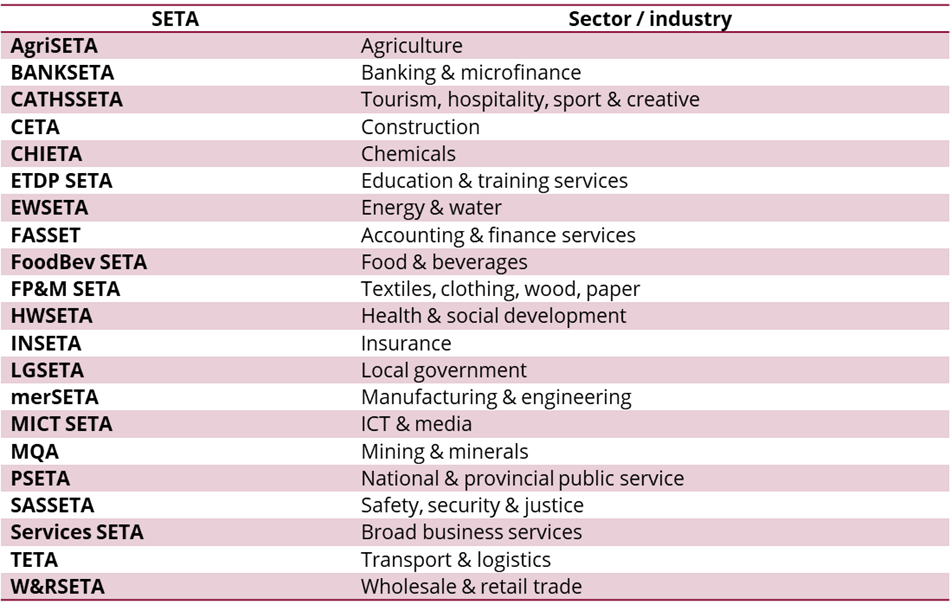
Each SETA has its own board, CEO and headquarters, plus regional offices to carry out its mandate. But sadly almost 30 years on the SETAs don’t have a whole lot to show for themselves. They are unable to spend the funds they collect, they train too few people and they have had no discernible impact on employment. Put simply, they have proven to be a waste of corporate taxpayers’ money.
Problem Number 1: Chronic underspending: SETAs are hoarding cash
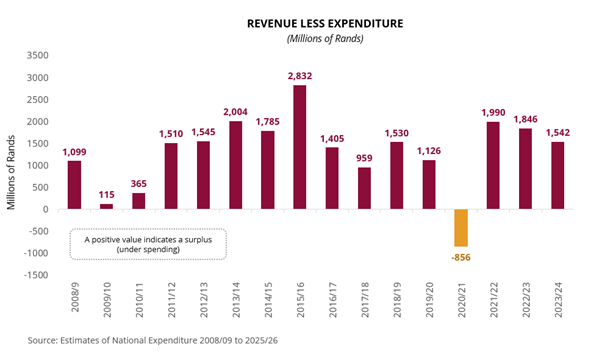
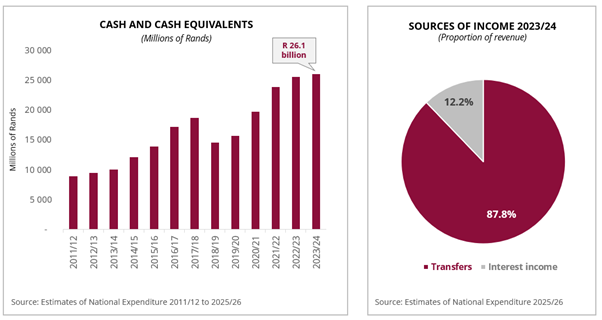
SETAs are chronic under-spenders of their budgets. There has only been one year since the late 2000’s where the SETAs recorded a deficit; and this was because of a payment holiday given to firms during the Covid-19 pandemic. Underspending results in SETAs hoarding mountains of cash, currently a whopping R26.1bn with cash and cash equivalents having risen by 78% in real terms since 2011/12. In fact, SETAs had so much cash at the end of the 2023/24 financial year, 12.2% of their revenue was from interest on those funds.
It is noteworthy that while SETAs are cash flush, South Africa’s universities are broke. Together, they are owed more than R8.8bn in unpaid student fees - money that is unlikely to be recovered. Operating losses and budget deficits have become the norm. UCT alone recorded a R360 million budget deficit in 2024. These mounting debts and deficits are forcing universities to freeze hiring, delay infrastructure maintenance and manage liquidity on a short-term basis.
Problem Number 2: Enrolment and throughput rates are low
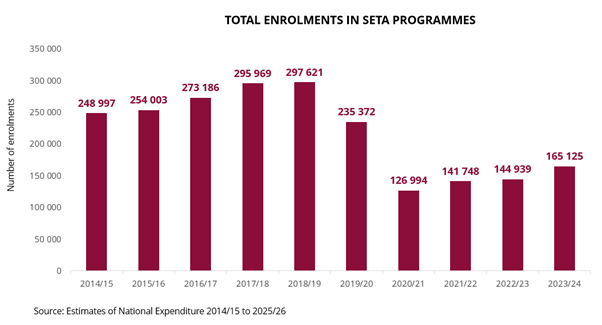
SETA enrolment has declined significantly from a peak of 297 621 in 2018/19 to just 165 125 in 2023/24, the latest year for which data is available.
In a recent paper, Botha and Havemann note that in 2023/24 the total number of SETA enrolments was just 0.7% of the labour force. Enrolment is a critical metric, but throughput is a more meaningful indicator of system performance. Between 2011/12 and 2023/24, just over 2.6 million South Africans enrolled in SETA funded Programmes. But just 2 million completed their training, with over 630 000 people dropping out. Note that the majority (almost half) of SETAs programmes are short and relatively simple skills training programmes, which have a 96% completion rate, biasing the overall throughput rate upwards.
Problem Number 3: Impact on employment is limited
Many who enrol in SETA programmes are already employed and are in the process of upskilling themselves – a critical goal of SETAs. But more interesting is to look at the impact of SETA programmes on unemployed individuals who go through the pipeline. It is this data that is particularly concerning. As per the schema below, between 2012/13 and 2023/24 over 655 000 unemployed individuals enrolled in a SETA programme including learnerships and skills programmes, as well as overall artisan and internship enrolments. Of these, just 65.7% completed the programme. Throughput rates aside, more worrying is labour market uptake. According to a recent study, just over 234 000 of these unemployed SETA graduates found employment.
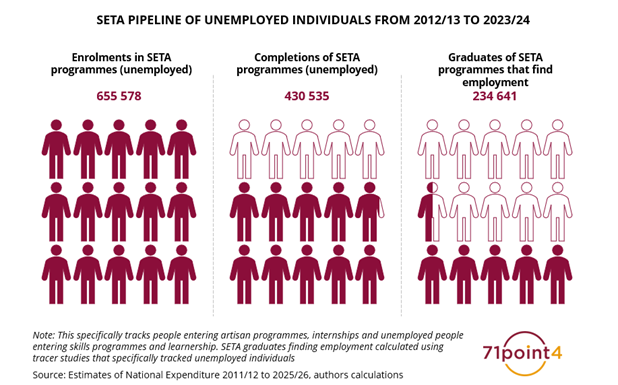
This is based on four tracer studies[1] conducted in the Education, Manufacturing, Insurance and Health industries that specifically track unemployed people that have entered the system. The average absorption rate (the proportion of programme participants that are employed after completing a SETA intervention) in the studies was only 55%.
A broader review of tracer studies (that don’t specify whether an individual was employed when entering the SETA system) shows a high degree of variability. Labour market absorption rates were as low as 6.1% in a study done on beneficiaries that completed W&RSETA internship programmes in the wholesale and retail sector. Another study on learners who completed merSETA learnerships or apprenticeships in the manufacturing and engineering industries found absorption rates as high as 83%, in 2013[2]
Problem number 4: Falling productivity, poor governance and repeated audit failures
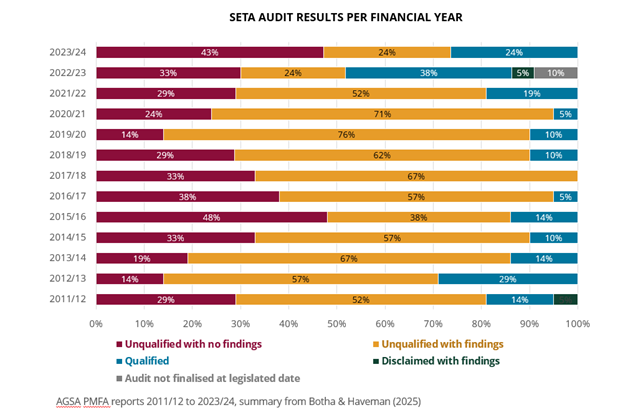
Beyond the weak outcomes and chronic underspending, SETAs display the same governance and efficiency failures that are endemic in most of South Africa’s public institutions. Over the past decade, only around 30% of SETA audits have been clean.
According to the auditor general, there has been just under R9.2bn of irregular expenditure over the same period. SETAs are regularly accused of corruption, from fake companies winning multimillion Rand tenders, to exam pads being procured for R200 each (R15 retail value).
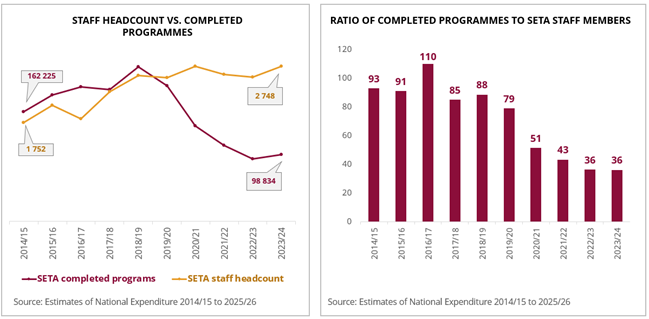
While enrolment has fallen, the wage bill and the staff headcount have grown rapidly over the last 10 years. The wage bill has grown at a nominal 12% per annum between 2015 and 2025 – well above inflation which was just under 5% during that period. Staff headcount has grown from 1 752 to 2 747 over the same period, with the average SETA employee earning R715 000 a year. And with the staff headcount going up, and the overall throughput going down simultaneously, the number of completed SETA programmes per SETA staff member (an indicator of productivity) was only 36 in 2024. This is a fraction of the peak in 2016 where there were 110 SETA graduates per staff member, suggesting SETA has become even more bloated, unproductive and costly.
Because of such low enrolment overall, each SETA registration ends up costing a massive amount of taxpayer’s money. Botha and Havemann (2025) estimate that it costs R162 879 per SETA enrolment. And because of such a low throughput, it rockets to a whopping R 388 052 per completed SETA programme. This is more expensive than a university graduate certification (R370 923), and way more than a university enrolment (R76 405), or even the average NSFAS funding per student (R73 829) or TVET college funding per student (R34 230).
Problem number last but not least: Flawed premise underpinning the rationale for establishing SETAs in the first place
Some analysts[3] argue that the very starting point of the SETA establishment process is flawed. Even efficient state-run entities will struggle to identify exactly which skills are in short supply in the labour market. In a recent paper, Matha and Jahed (2024) note that the 21 SETAs use a “fragile, non-scientific and compliance-based method, reliant almost entirely on employer forms, rather than robust data analysis” to identify shortages and labour market demand. It’s evident that the SETAs rely heavily on a single, weak data source: “Hard-to-fill-vacancies” reported by employers in their Workplace Skills Plans (WSPs) and Annual Training Reports (ATRs). They point out that many employers don’t submit said plans or reports, and if they do, it is a compliance exercise performed perfunctorily. The qualitative underlying factors behind the hard to fill posts (such as geography, working conditions, remuneration) are seldom analysed, and so vacancies are wrongly interpreted as skills shortages.
One would be hard pressed to argue that a state-run bureaucracy in South Africa could ever reliably diagnose, let alone close, the skills gap created largely by the country’s (state-run) education system. Indeed, judging by the SETAs’ performance, it appears the SETAs can’t even reliably diagnose or close their own skills deficits. Perhaps it is time to wind them down.
[1] ETDP SETA & Human Sciences Research Council (HSRC). (2020), FoodBev SETA. (2024), INSETA. (2024), INSETA. (2024)
[2] Erasmus, J., Monyokolo, M., & Coetzee, M. (2013), Matha, K. & Jahed, M. (2013).
[3] Matha, T. & Jahed, M. (2024). A critique of the techniques used by the Sector Education and Training Authorities (SETAs) to detect skills shortages in South Africa. Administratio Publica, 32(4), 1–19. Available here: https://journals.co.za/doi/10.61967/adminpub.2024.32.4.8
Sources
Auditor-General South Africa (AGSA). (2024) Consolidated General Report on National and Provincial Audit Outcomes: PFMA 2023/24. Pretoria: Office of the Auditor-General.
Botha, F. & Havemann, R. (2025). The effectiveness of Sector Education and Training Authorities in South Africa. Policy Paper 42. Cape Town: Economic Research Southern Africa (ERSA) / Bureau for Economic Research (BER).
Daily Maverick. (2025) ‘Corruption and collapse: How Services SETA blew R163 million and broke SA’s skills promise’, Daily Maverick, 29 July. Available at: https://www.dailymaverick.co.za/article/2025-07-29-corruption-and-collapse-how-services-seta-blew-r163-million-and-broke-sas-skills-promise/
Erasmus, J., Monyokolo, M., & Coetzee, M. (2013). Tracer study of learners who completed learnerships and apprenticeships funded by the Manufacturing, Engineering and Related Services SETA (merSETA). HSRC & merSETA, Pretoria.
ETDP SETA & Human Sciences Research Council (HSRC). (2020). Track and Trace Evaluation Study: Tracer Study of Beneficiaries 2015/16–2018/19. Pretoria: Education, Training and Development Practices SETA.
FoodBev SETA. (2024). Impact and Tracer Study on Unemployed Learners (2018/19–2020/21 cohorts). Johannesburg: Food and Beverages Manufacturing Sector Education and Training Authority.
HWSETA. (2020). Track and Tracer Study Technical Report 2019/20 and Six-Year Synthesis (2014/15–2019/20). Pretoria: Health and Welfare Sector Education and Training Authority.
INSETA. (2024). Tracer Study: Learnerships 2016/17 – Final Findings Report. Johannesburg: Insurance Sector Education and Training Authority.
Matha, T. & Jahed, M. (2024). A critique of the techniques used by the Sector Education and Training Authorities (SETAs) to detect skills shortages in South Africa. Administratio Publica, 32(4), 1–19.
Matha, K. & Jahed, M. (2013). Tracer study of learners who completed the Wholesale and Retail SETA internship programme. W&RSETA Research Department, Pretoria.
merSETA. (2016) Tracer Study Final Report 2016. Johannesburg: Manufacturing, Engineering and Related Services Sector Education and Training Authority.
National Treasury. (2025) Estimates of National Expenditure 2025. Republic of South Africa.
World Bank. (2020). Skills Development in South Africa: Identifying Issues for Further Analysis. Washington, DC: World Bank.
